
Outcome-Based Pricing: What Coforge's 6% Actually Means
Street is excited to see Coforge talk about outcome based pricing, but it's an edge case.

Coforge did something this quarter that very few were expecting - show % of work now billed based on outcomes. For long we have talked about IT billing models but it’s for the first time someone has quantified it. Coforge put a number on the table this quarter and the industry has been quoting it ever since. On the Q1 FY27 call on 28 July, CEO Sudhir Singh said outcome-based contracts are running at 6 to 7 percent of global revenue. Suddenly, everyone is talking & writing about on LinkedIn. Almost none of them explained what it means.
The interesting part was not the number. It was the follow-up. When ICICI’s Aditi Patil asked, plainly, how pricing is actually done in these contracts, Singh gave three examples. Read them closely and you learn more about the real state of outcome pricing than any headline slide will tell you.
What Coforge Described
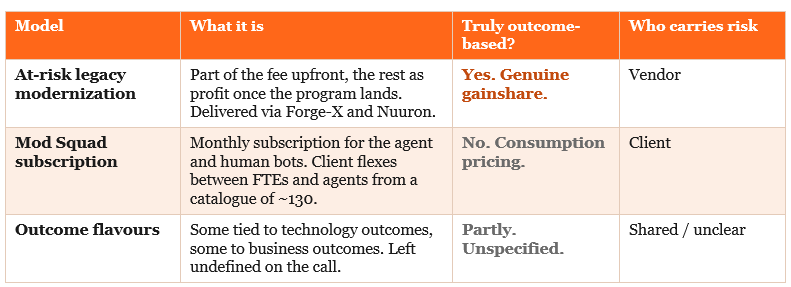
Table 1 | The three constructs Coforge named on the Q1 FY27 call.
The first model is the real thing. On an at-risk legacy modernization, Coforge bills only part of the fee it would normally earn for the effort, and takes the rest as profit once the program lands. Management called that post-success margin super normal. That is genuine gainshare. The vendor carries delivery risk and gets paid for the result rather than the hours.
The second is a monthly subscription for the Mod Squads, the hybrid agent and human bots, with the client flexing between human FTEs and agents drawn from a catalogue of roughly 130. That is a consumption model. It prices a unit of capacity rather than an hour, which is a real change from time and materials, but it is not paid on any outcome. Coforge folds it into the outcome bucket anyway. Worth remembering when you read the 6 to 7 percent.
The third is a set of flavours tied to technology outcomes in some cases and business outcomes in others. Management left this vague. That is exactly where the KPI question belongs.
What is “Paid disproportionately” in reality?
The phrase doing the heavy lifting is super normal profit. It sounds like a pricing trick. It is really a cost story.
Here is the mechanism with round numbers. Treat them as illustrative, not as Coforge figures.
A legacy modernization that once needed a hundred people over eighteen months might have been a 15 million dollar time and materials program. Say 11 million of that was labour cost and 4 million was margin, so about 27 percent. Now the same scope gets delivered with modernization agents and thirty people, and the cost to serve falls to around 4 million. Coforge does not price to that new cost. It prices to the old value and puts a slice at risk.
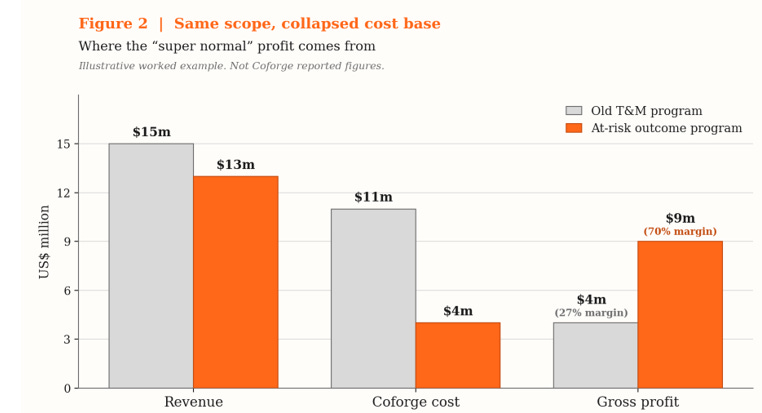
Something like a reduced running fee of 6 million while the work is underway, which is what protects the client, plus a success fee of 7 million that only lands if the modernization completes and cuts over clean. The client pays 13 million in total, slightly less than the old 15, and gets transferred risk on top. Coforge spent 4 million to earn it. On 13 million of revenue that is roughly 70 percent gross margin against the old 27.
That gap is what disproportionate means. The profit is out of proportion to the effort, and to what the same work yielded under time and materials. It is not free money. If the program slips badly or fails, the 7 million walks, and the thin running fee can leave the account underwater. The vendor is being paid a risk premium for putting its own fee on the line. The reason it can afford the bet at all is that AI has decoupled its cost from headcount. Once agents do most of the work, a fixed outcome price stops being reckless.
How an outcome gets defined
Strip the marketing and outcomes fall into three buckets, plus a fourth that keeps getting tagged in.
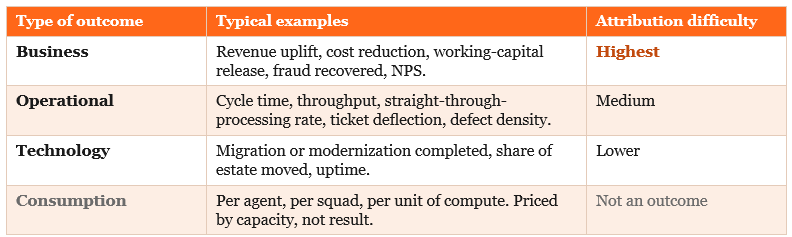
Coforge’s own client proof points from the same call sit almost entirely in the operational row.
A Latin American bank targeting 30 to 50 percent higher delivery throughput.
An investment services firm with cycle times down 80 percent.
A specialty insurer with technical debt cut 92 percent and productivity up 65 percent.
An automotive client with documentation effort down 70 percent and operating cost down 35 percent.
These are operational KPIs with dollar values attached. The genuinely business-level outcomes, the revenue and working-capital kind, are the rarest, because they are the hardest to pin on the vendor.
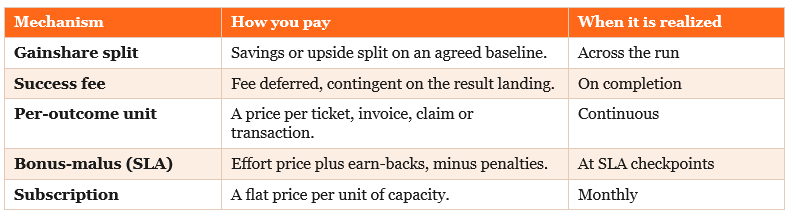
On top of the outcome definition sits the question of how money actually moves.
The timing problem
Here is the part that matters most, and it is the part the disclosure skips.
Operational and business outcomes can only be measured in steady state, after go-live. But a transformation program burns cash for several quarters before that. So when the outcome sits in the run phase and the vendor still needs to fund the build, the money has to be structured around the gap. In practice it happens three ways.
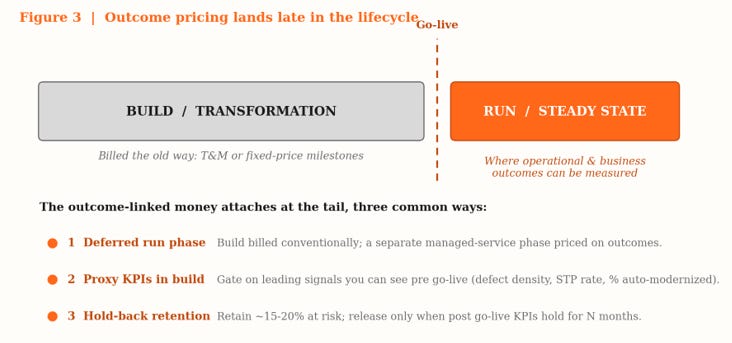
The build gets billed conventionally and a separate run phase is priced on outcomes, which parks the outcome revenue in the managed-services tail. Or the contract gates payment on proxy KPIs you can see before go-live, which are really quality metrics wearing an outcome costume. Or a slice of the fee, commonly 15 to 20 percent, is held back and released only when post go-live numbers hold.
Follow that logic and the honest description of most outcome-based work becomes clear. The body of the program is billed the old way. The outcome layer attaches at the edge, as a deferred phase, a proxy gate, or a retained hold-back. The fully contingent version, where the entire scope rides on a single completion event, is the exception, and it lives mostly in the technology-outcome model rather than the business-outcome one.
A lot of it is the edge
Motilal Oswal’s Abhishek Pathak noticed something and asked about it. Coforge’s time and materials share has actually inched up over recent quarters, even as outcome-based is supposedly the direction of travel. Singh did not really reconcile it. He restated the 6 to 7 percent and moved to the margin point.
The two facts stop fighting once you accept the timing. A fast-growing transformation pipeline shows up as time and materials and fixed-price build work now. The outcome layer only crystallizes later, as those same programs mature into run. Rising T&M today and a rising outcome share over time are the same pipeline seen at two points in its life.
How to read the 6 percent
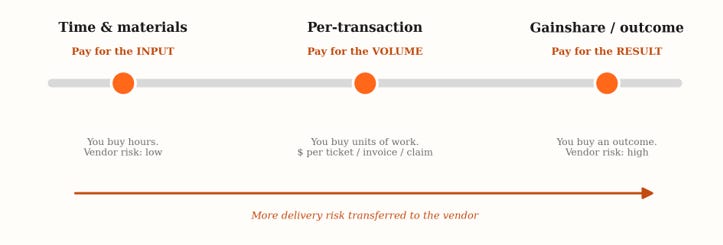
Take the number at face value and you will overstate the shift. Read it as the share of revenue where the price is no longer a straight function of hours, and you are closer to the truth. Inside that share sit genuine gainshare deals, a subscription model that is not outcome pricing at all, and a set of technology and business gates whose weighting Coforge has not broken out.
The measurement tools underneath, the KPIs, the SLAs, the agreed baselines, are the same ones managed services has used for twenty years. What has changed is which party carries the risk and what the price is indexed to. AI is the reason a vendor can now index price to a result and still protect margin. That is real, and it is early.
Three things worth watching from here. Whether Coforge starts breaking the 6 to 7 percent into its parts, which would tell you how much is true gainshare. Whether the managed-services annuity grows, since that is where sustained outcome revenue would actually show up. And whether the margin trajectory holds as more fee moves at-risk, because the super normal profit and the risk of a program going the other way are the same coin.
Disclaimer: This is not investment advice. Companies are named for discussion and reference only. All figures are as reported on the Coforge Q1 FY27 earnings call and in public disclosures; the worked example is illustrative and does not represent Coforge’s reported economics. Please do your own research and mind your own risk tolerance.